Resources
Sustainability intelligence, made practical.
Thought leadership, customer stories, and original research from the team building the AI engine for sustainability.

AI playbook for portfolio monitoring and stewardship
Download the playbook
How KingSett Capital uses Manifest Climate to maximize positive environmental impact
KingSett Capital is a private equity real estate investment firm in Canada. Its $18 billion in assets is funded by its own capital, alongside that from institutional investors and ultra-high-net-worth individuals. KingSett’s real estate asset classes include office, retail, industrial, multi-family, hotels and developments. KingSett also creates bespoke financing solutions for a wide range of projects […]
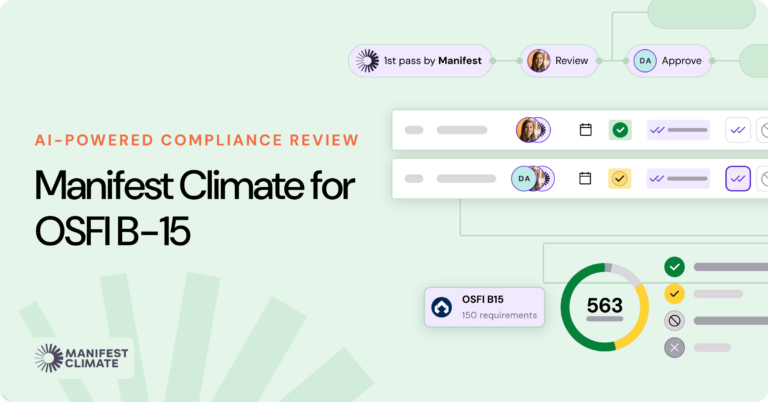
Why are financial institutions still assessing OSFI B-15 compliance manually?
A guide to automating the ESG compliance auditing process Federally regulated financial institutions in Canada are under increasing pressure to disclose their climate risk under a variety of standards — in particular, OSFI B-15. For most companies, assessing OSFI B-15 can be a painstaking manual process that consumes their sustainability or compliance teams, taking time […]
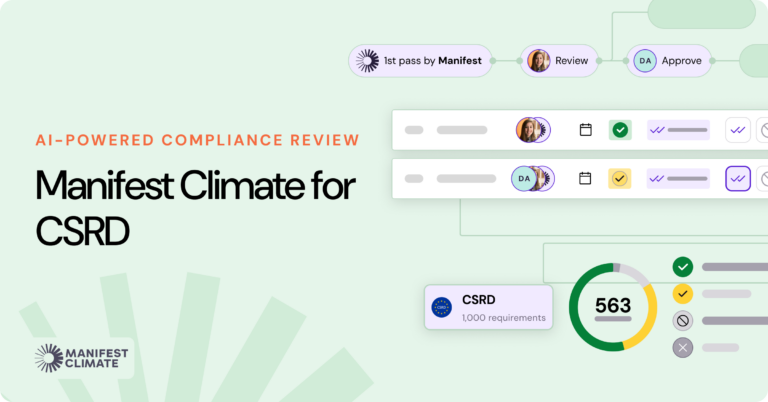
How to assess CSRD compliance faster than traditional audits
Complying with the Corporate Sustainability Reporting Directive (CSRD) requires companies to truly overhaul their ESG disclosure. For most companies, complying with the CSRD’s ESRS standards will mean combing through every part of their business—strategy, operations, governance, and supply chains—to surface data that is often buried in different systems and teams. That means weeks of manual […]

Business is booming for ESG auditors. Can they keep up?
As ESG disclosures move from voluntary to mandatory, the role of the ESG auditor is now in the spotlight. Companies that provide ESG auditing and assurance services are no doubt seeing more client requests than ever before, but can they keep up with the demand? Faced with assessing compliance across a broad array of concerns […]

For responsible investors, data is the missing link in ESG decisions
In the era of responsible investing, an investment firm’s chief asset is increasingly data. Without the right data on companies’ ESG performance, portfolio managers and their teams are flying blind, unable to identify and retain the right companies to please their investors and hit financial or sustainability targets. But for the most part, investors are […]

Stewardship teams don’t have the ESG data they need to make an impact — here’s why
In today’s investment landscape, ESG stewardship is a key priority. In theory, evaluating ESG performance and engaging companies to improve should be straightforward, but most investment stewardship teams are facing major obstacles, many of which lead back to a single problem: getting the right data. The right data is a critical guide for stewardship teams […]
How High Liner Foods builds climate competence internally
High Liner Foods is a leading frozen seafood supplier in North America, sourcing and processing over 20 species from all over the world. In 2024, the company celebrated its 125-year anniversary. With a long legacy behind it, High Liner Foods is focused on building a sustainable future. The company’s sustainability team is intensely focused on […]
Manifest Climate helps Ceres make sense of climate data to drive change
Ceres Accelerator for Sustainable Capital Markets is a nonprofit advocacy organization working to accelerate the transition to a cleaner, more just, and sustainable economy. The organization works with companies, investors, policymakers and regulators to educate, advocate, and investigate opportunities and challenges in the net zero transition. Ceres reached out to Manifest Climate for a unique […]
How a Mining Company uses Manifest Climate to Help Transition to a Climate-Positive Future
Teck Resources Limited (Teck) is a leading Canadian resource company focused on responsibly providing the metals essential for global development and the global energy transition. The company operates a smelter and copper mines and zinc mines across the Americas. Teck leverages Manifest Climate to rapidly improve and iterate on its climate disclosures. With changing external […]
Stay in the loop
Get the Manifest Memo.
Where AI meets sustainability. Practical insights for teams building faster, evidence-based workflows.
By subscribing you agree to our Privacy Policy.