
What is ESG analysis? Environmental, social, and governance (ESG) analysis is the process of evaluating how a company discloses, manages, and performs in relation to sustainability issues. It goes beyond treating ESG as a compliance concern. Instead, sophisticated ESG analysis is about interpreting that information in a way that’s aligned with global reporting standards, investor […]
Role: Corporate Sustainability
How agentic AI is shaping ESG research

There is more environmental, social, and governance (ESG) data than ever, yet sustainability teams, ESG advisors and responsible investors are finding that the research component of their jobs is not getting any easier. Disclosure rules are tightening. Stakeholder expectations are growing. And the volume of reports, standards, and frameworks to parse through? It’s overwhelming. Even […]
Mind the gap: AI analysis of the fortune global 500 sustainability disclosures

See how AI is bringing clarity to climate ambition Manifest Climate’s latest report uses our proprietary AI to analyze 50,000+ sustainability datapoints from the Fortune Global 500. The result? A first-of-its-kind view into how companies are turning climate commitments into measurable, decision-useful action. What we uncovered: This report surfaces the signals that matter, revealing where […]
Level Up Your Sustainability Benchmarking with AI: Insights from Manifest Climate and PwC
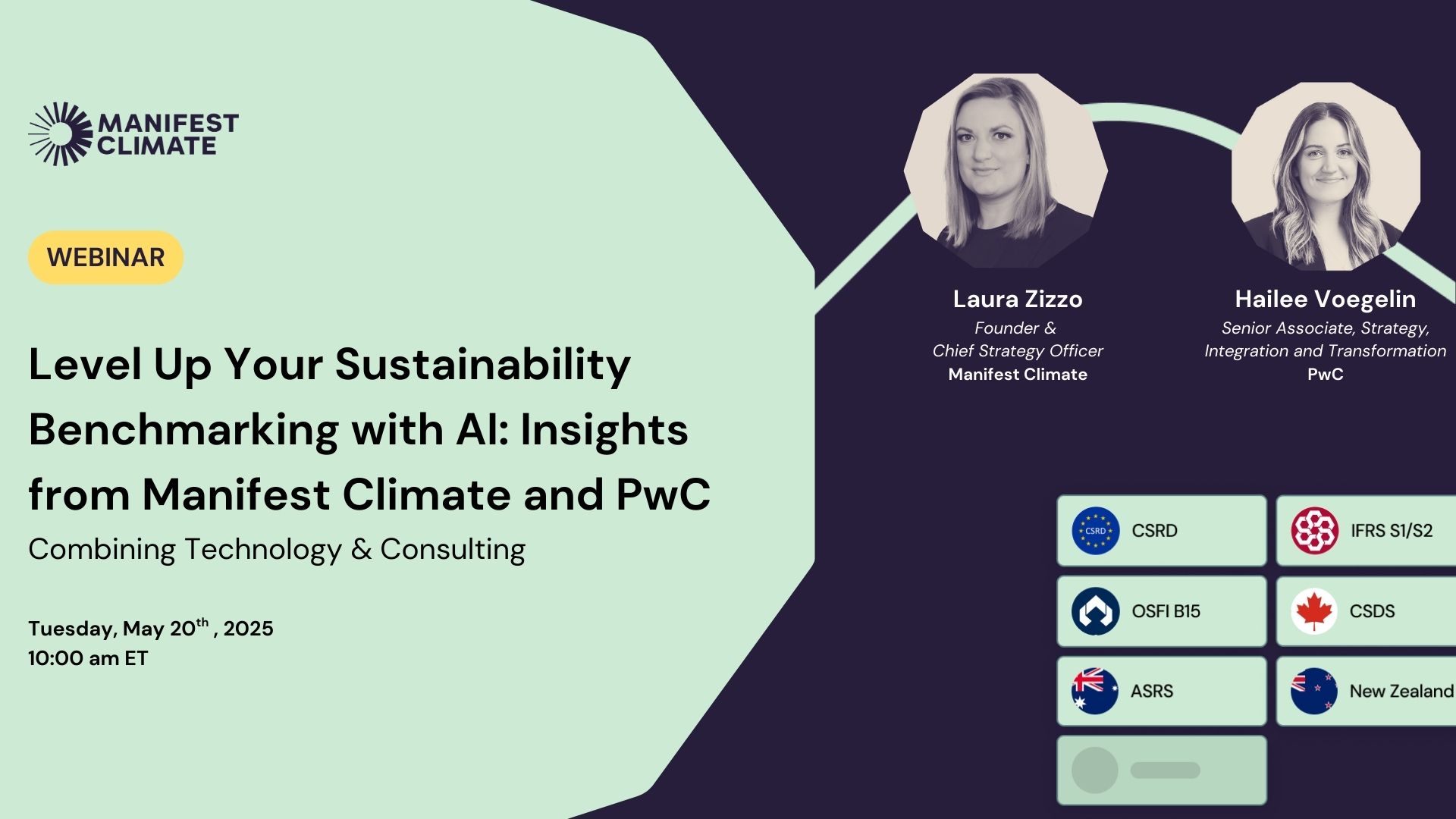
Effective sustainability benchmarking goes beyond emissions data and third-party ratings—it requires real-time, reliable, and comparable insights across a broad spectrum of environmental, social, and governance (ESG) topics. In this webinar, we introduce Manifest Climate’s new AI-powered Benchmarking Comparison feature—designed to help sustainability consultants, investment teams, and stewardship professionals simplify and scale their benchmarking efforts. Discover […]
The Top 5 ESG Reporting Tools (used by the world’s largest companies)

A 2024 KPMG survey revealed that 96% of the world’s largest 250 companies now report on ESG standards and practices, highlighting a major shift in corporate priorities. ESG reporting tracks your company’s environmental, social, and governance performance and is a key tool for driving corporate sustainability management. It gives you a clear view of how […]
How to guide businesses through ESG policy development and compliance

Well-defined environmental, social, and governance (ESG) policies are essential for managing sustainability risk. As regulations tighten and stakeholder expectations grow, companies need structured policies that guide decision-making and hold teams accountable. But building those policies isn’t straightforward. ESG expectations vary across sectors, regions, and regulators. Many organizations are still figuring out how to turn high-level […]
A comprehensive guide to ESG reporting requirements

ESG (Environmental, Social, and Governance) reporting is no longer a voluntary movement. Most companies over a certain size now have mandatory ESG disclosure requirements, wherever they’re located. For consultants, compliance teams, and sustainability advisors, this shift means getting serious about which rules apply, what data to track, and how to guide clients through the reporting […]
ESG data overload: 6 best practices for simplifying ESG research and assessments

Over the past few years, environmental, social, and governance (ESG) data has moved from being a niche topic to a core consideration in the business and investment world. A recent 2024 survey by Deloitte and The Fletcher School at Tufts University found that 83% of investors now include sustainability information in core investment decisions. This […]
ESG gap analysis: how to find and close disclosure gaps

An ESG gap analysis shows where your disclosures fall short of framework, investor, and assurance requirements, and how to find those gaps at scale.
Navigating IFRS S2: How ESG consultants can help businesses adapt

As climate disclosure standards evolve, the International Sustainability Standards Board (ISSB) is leading the shift toward more structured reporting. ISSB’s International Financial Reporting Standards (IFRS) S2 Climate-related Disclosures establishes clear requirements for identifying, assessing, and reporting climate-related risks and opportunities—ensuring greater transparency for investors and stakeholders. The primary goal of IFRS S2 is to provide […]